
The Polkura Hill is located in Marchigüe, the Eastern slope of Colchagua Valley’s Coastal Range, less than 30 kilometers from the Pacific Ocean.
The area is defined as climatic transition zone. The moderately heigh coastal range allows the trespassing of some marine breezes especially in the afternoons, moderating higher temperatures coming from the central part of the valley, enabling a steady and consistent ripening of the grapes.
This environment results in wines with fresh and spicy expression, more typical of cooler wine regions, with notes of black pepper and herbs, but with a broad, deep, and textured palate, typical of warmer climates. This tension between freshness and structure defines the character of Polkura.
Marchigüe ancient soils of volcanic origin volcanic are relatively poor. They were formed on site, without the influence of alluvial deposits from rivers. In the Mapuche language, “POLKURA” means yellow stone, referring to the large amount of yellow granite distributed at different depths in the clay soils of the area. The decomposed granite gives the wine minerality and elegance, while clay provides body and structure.
Although POLKURA has practically all sun exposures, most blocks are oriented toward the south and west. The most interesting parcells are those facing directly south, with less direct sunlight. These areas get fewer hours of sunlight and therefore lower heat accumulation, resulting in much more elegant wines.

El granito descompuesto se
combina en este caso con un
mayor contenido de arena y
las arcillas rojas se
reemplazan por arcillas más
grises. Aquí también se
producen lotes de muy buena
calidad y equilibrados.

Suelo presente en dos
sectores del viñedo. Es el
suelo más pobre de todos
con alto contenido de
piedras. En él se generan
vinos con una carga tánica
importante. Sus arcillas rojas
entregan cuerpo y textura a
los vinos.

Suelos con un mayor
contenido de arcillas y por lo
tanto con mayor retención de
agua. Los vinos producidos
aquí aportan frutosidad a la
mezcla.
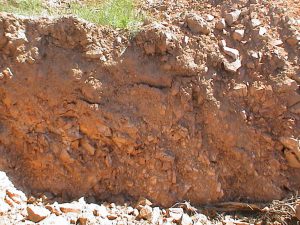
Suelo presente en dos
sectores del viñedo. Es el
suelo más pobre de todos
con alto contenido de
piedras. En él se generan
vinos con una carga tánica
importante. Sus arcillas rojas
entregan cuerpo y textura a
los vinos.

Los "mejores" suelos del
sector para la producción de
vinos de calidad. En ellos se
amalgaman las arcillas rojas,
el granito descompuesto y un
buen nivel de materia
orgánica. Son suelos en muy
buen equilibrio.
At the same time, all rows—regardless of slope—are planted from north-northwest to south-southeast to prevent direct sunlight on the grapes during the warmest hours of the day, avoiding sunburn and dehydration.
Polkura’s total vineyard surface is 30 hectares, about half of which is planted with Syrah coupled with other varieties have been planted expressing a very particular character in this area. The reason is to add more flavors to the blends and increase complexity. These include Malbec, Grenache Noir, Mourvèdre, Tempranillo, Viognier and Grenache Blanc.
After starting in 2003, in 2005, an additional 12 hectares were planted with Cabernet Sauvignon, Merlot, and Cabernet Franc, initially to sell grapes to other wineries. Since 2015, we have also vinified them ourselves.
In 2009 and 2016, we planted a total of 5 hectares under dry farming (without irrigation), mostly Syrah and some Grenache Noir.
The oldest section, planted in 2003, is entirely on its own roots (ungrafted), allowing a more direct expression of the vineyard. Newer plantings use drought-resistant rootstocks.
Since 2009, we have developed 2 hectares without irrigation in a different area of the property. To prevent water loss, this is done in flat terrain with soils able to retain water during the long dry season. In 2016, we expanded by 3 more hectares.
There are two reasons to produce wine without irrigation. First, it allows a full expression of the place with minimal intervention. Second, given the decreasing availability of water for irrigation, it is necessary to learn to survive without it.
Planting density is 2,500 plants per hectare, less than half of conventional vineyards, reducing competition for water.
A high clay content is needed to retain water from September to April.
We use the “Echelas” (single post) system, tying shoots to a central support rather than letting them grow freely. (en español reemplazar gobelet con “Echelas” (estaca individual)
Rootstocks
The vineyard was planted on drought-resistant material to ensure success.